From the legend of Liotru to the art of Vito Guardo: Lava Stone sculpted through time

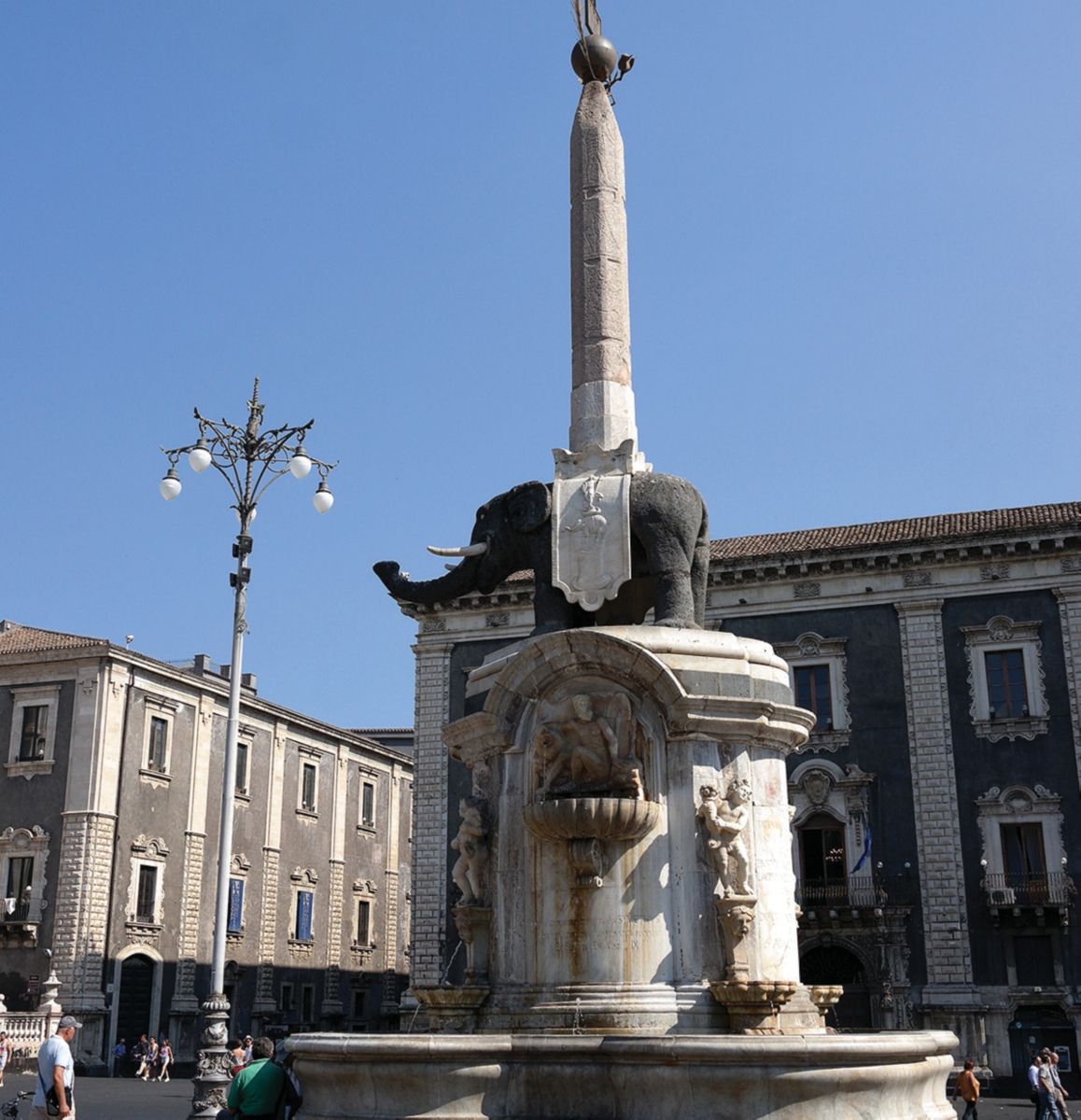
Lava stone, shaped by the fire of Mount Etna, has for centuries been a material that fascinates and inspires, capable of transforming into symbol, legend, and art. In Catania, its most famous emblem is the Fountain of the Elephant, known as “U Liotru”, which rises in Piazza Duomo and has accompanied the life of the city for centuries. There are no certain records of when and by whom the statue of the elephant was created. Over the centuries, scholars and chroniclers have sought to provide answers, often weaving together history and myth. In 1639 Pietro Carrera wrote that the Liotru celebrated a victory of the people of Catania over the Libyans; later, Ignazio Paternò Castello claimed that it came from a circus, while Santi Consoli and Matteo Gaudioso linked it to the memory of a religion now lost.
Today, the interpretation offered by the geographer Idrisi during his travels in Sicily in the 12th century is widely accepted: he recounted that, the people of Catania regarded the elephant as a magical statue, capable of protecting the city from the eruptions of Mount Etna. Idrisi also reported that the sculpture was created during the Carthaginian or Byzantine rule and that, as early as the 12th century, it stood within the city walls. It is said that the Benedictine monks of the Monastery of Sant’Agata placed it under an arch known as “di Liodoro”. In 1239 the statue was chosen as the official symbol of Catania and, according to some, was moved within the city walls at that time.
Over the years, the Elephant underwent relocations and restorations. In 1508 it was placed on the western (or northern) side of the Town Hall and accompanied by the inscription “Ferdinandus. Hispaniae utriusque. Siciliae. Rege - Elephans erectus fuit a Cesare Jojenio - Justitiario - MDVII”. Severely damaged by the earthquake of 1639, which broke its trunk and legs, it was restored by the architect Giovanni Battista Vaccarini in 1735, at the request of Filippo D’Orville. As for the obelisk that crowns it, it is believed to have arrived in Catania during the Crusades, from Svene, and to have been initially placed in the Circus Maximus, as hypothesized by Ignazio Paternò Castello.
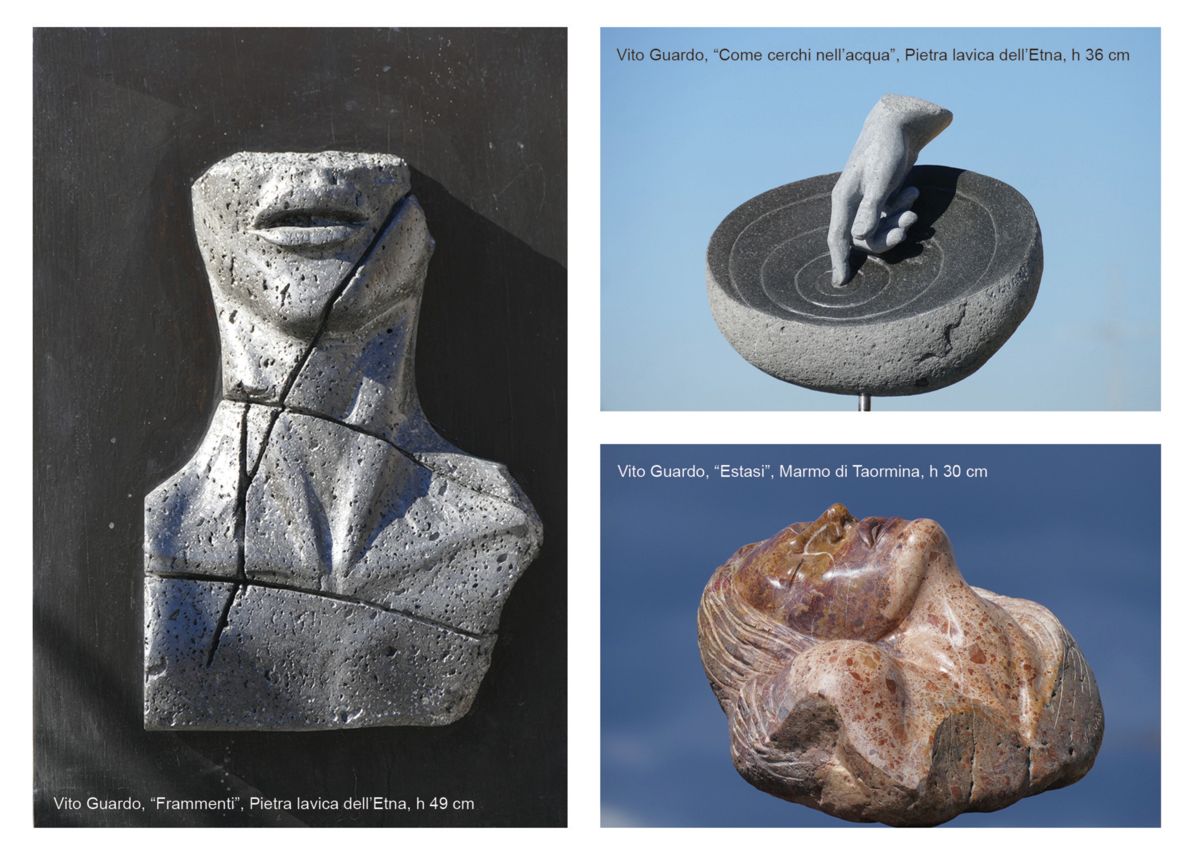
This millenary statue, sculpted in lava stone, continues to embody the identity of Catania, standing as a point of connection between myth and history. But the tradition of working this dark and resistant material does not belong solely to the past: it still lives today in the hands of contemporary artists. Among them is Vito Guardo, a sculptor born in Catania in 1965. His artistic training began at the Art Institute, where he graduated as Maestro d’Arte in 1982. The following year he moved to Florence and attended the Institute of Art and Restoration, where in 1987 he earned a diploma in wood restoration. His education was completed in Rome, at the Academy of Fine Arts, where he graduated in sculpture under the guidance of master Emilio Greco.
Since 1985 Guardo has exhibited in numerous solo and group exhibitions, from Rome to Lecce, from Chianciano Terme to Pienza, from Avellino to Erice, always receiving great acclaim. Some of his works are permanently displayed at the Orsa Maggiore art gallery in Lido di Ostia, Rome. Since 1996 he has successfully participated in sculpture symposia and competitions, both in Italy and abroad, consistently ranking among the top and standing out for the expressive power of his creations. Vito Guardo’s renown is particularly linked to his public works in wood, bronze, marble, and especially lava stone, which has become the distinctive hallmark of his art.
His sculptures, often of sacred themes, enrich churches and spaces in the province of Catania, where volcanic matter once again becomes a vehicle of spirituality and a symbol of the deep bond between man and his land. From the ancient Liotru to the creations of Vito Guardo, lava stone continues to represent far more than just a material: it is memory, identity, and art, a bridge uniting myth and the present, roots and contemporaneity.