10)Poligem celebrates its thirtieth anniversary
Diamante A&T Contents Issue 124
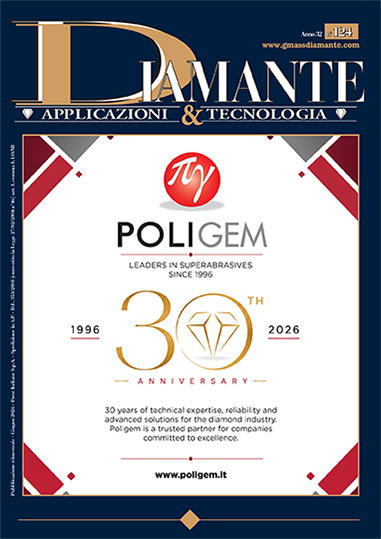
Click on the COVER to browse the Preview
of Issue 124.
The digital Preview includes a free selection of our contents
and the abstracts of the technical articles.
Front Cover: POLIGEM SRL
Poligem is a private independent company that has been a leader in the superabrasive market since 1996. Thanks to the experience accumulated in the synthesis, selection and grinding of the diamond, Poligem has been for years a constant presence in Europe in the tools, abrasives and non-conventional diamond applications sectors. From natural diamond to synthetic diamond, from polycrystalline diamond to Cubic Boron Nitride, Poligem is able to respond with the best solution to the needs of the industry.
In the Spotlight
14)35.BI-MU: plenty of new features for an edition rich in thematic insights
Stone
21)The original stone materials, an essential element for the proper maintenance of monumental cultural heritage
Part II - How to ensure correct replacement maintenance
Diamond Tools
39)Experimental investigation on the effects of tool geometry and cutting conditions on machining behavior during edge finishing of granite using concave and chamfered profiling tools
Abstract: Granite edge finishing through grinding is a common process in the granite processing industry, crucial for achieving the final desired shape and edge quality of products. This study focuses on the granite industry, specifically delving into the significance of grinding and polishing for improving aesthetics and extending material longevity. The experimental design entails a comprehensive factorial experiment plan involving two workpiece materials (white and black granite samples) and two cutting tool edge shapes (chamfer and concave), each with two grit sizes: G150 and G600. The cutting conditions varied and consisted of variations in spindle speeds (1500, 2500, 3500 rpm), feed rates (500, 1000, 1500 mm/min), and lubrication modes (wet/dry). The results uncover intricate relationships among these parameters and part quality, underscoring the pivotal role of tool geometry in achieving superior surface finishes and in controlling the cutting forces. These findings contribute to a nuanced understanding of the dynamic interplay between tool characteristics, material properties, and machining conditions within the granite industry...Innovation
55)Research progress on additively manufactured diamond tools - Part 1
Abstract: With their exceptional hardness and wear resistance, diamond tools hold an irreplaceable position in critical fields such as precision machining, geological exploration, and construction engineering. However, traditional manufacturing processes like powder metallurgy still face numerous limitations in terms of structural design optimization, the controllability of diamond particle distribution, and the shortening of production cycles. In recent years, additive manufacturing has emerged as a disruptive technology that precisely constructs three-dimensional structures in a layer-by-layer manner, offering new possibilities for the customized design and functionally integrated manufacturing of high-performance and complex-structured diamond tools. This paper systematically reviews the recent research progress on the additive manufacturing of diamond tools. It focuses on summarizing the fabrication characteristics and performance of metal-bonded diamond tools, resin-bonded diamond tools, and ceramic-bonded diamond tools prepared by different additive manufacturing processes. On this basis, the paper further discusses the key technical challenges and future development directions in this field, with the aim of providing a theoretical reference and technical guidance for the design optimization and engineering applications of additively manufactured diamond tools...Recycling
67)Microstructure and mechanical properties of zinc recycled tool grade cemented carbide inserts
Abstract: A production run of mixed carbide inserts was scrapped. These inserts were zinc recycled and approximately 70% metal recovery was achieved, while 30% was Co-rich oversized particles. The recovered powder was divided into two batches with one adjusted for C and the second for C and Co. The powders were used to produce sintered compacts, and the properties were benchmarked against compacts produced from the original powder. Acceptable shrinkage with comparable densities and low porosities were achieved for all. Cubic-free surface layers (CFL) formed in all alloys with a narrower layer in the recycled alloys. Although the carbide grain structure differed between the alloys, the TaC and NbC restricted grain growth effectively. A linear inverse relationship was found between Co in the CFL and Ti immediately beneath the CFL for all alloys. Similar magnetic, hardness, fracture toughness and slurry abrasion properties were measured with some deviations for the higher Co alloy...Browse Issue 124 online
Would you like to download the full issue? Subscribe here