Regional initiative: second update of the “Sicily Quarry Plan”
Proposed by the Etna Lava Stone Consortium

The Etna Lava Stone Consortium plays an important role in the planning of the regional planning instrument known as the “Sicily Quarry Plan”, as it acts as the proposing body for new areas in which the establishment of quarrying activity is considered admissible. With public notice dated 23/05/2025, the Sicilian Region reopened the deadlines for the second update of the Sicily Quarry Plan, inviting Municipalities and trade associations to submit new Quarry Plan proposals, to be subject to the technical-environmental assessments of the various Regional Departments. The technical coordination of the drafting of the Quarry Plan update was entrusted to Dr.
Ambrogio Alfieri, head of Service 9 - Geological and Geophysical Service - of the Energy Department of the Regional Department for Energy and Public Utility Services. The Etna Lava Stone Consortium, within the framework of the second update initiative of the Quarry Plan, submitted 37 proposals for new areas with quarrying potential, accounting for more than 50% of all the proposals received from the entire regional territory, involving deposits of various geological nature, essential to guarantee the supply of quarry materials both to the ornamental stone sector and to the construction materials sector. The update of the Quarry Plan represents a strategic act for the future of the lava stone supply chain, which is currently suffering from the limited availability of raw material due to the increasingly small number of active quarries and the strong supply demand coming from the numerous private and public construction sites in eastern Sicily.
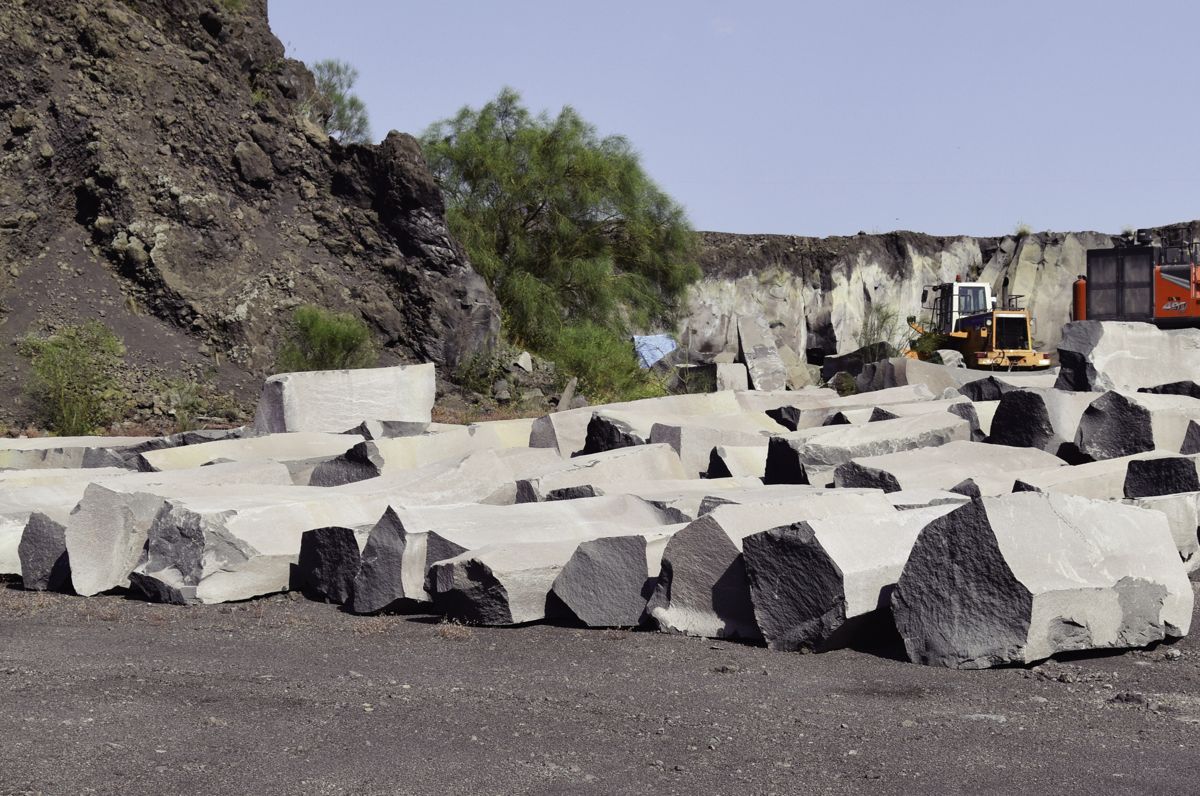
According to a recent study on the actual consistency of the lava stone deposits authorized by the Sicilian Region for quarry exploitation, it is estimated that within 7 years there will be a collapse in the supply of lava products due to the depletion of the authorized deposits, with the consequence that the entire supply chain production risks being irreversibly compromised. Therefore, in order to avert the collapse of the supply chain, the Etna Lava Stone Consortium has undertaken to identify new high-quality lava stone deposits throughout the Etna area, suitable for the production of sawing blocks and construction aggregates, by preparing the 37 proposals for new Quarry Plan areas which are currently under examination by the regional interdepartmental evaluation commission.
Furthermore, the search for new quarry deposits has strategic value and is closely linked to the implementation of public infrastructure connected with the NRRP, for which the supply of quarry raw materials is indispensable to guarantee completion of the works. Therefore, diligent land-use planning of quarries can only result in a high level of socio-economic development for Sicily, at a time when the investment plans currently under implementation have reached an unprecedented financial allocation. Particular attention has been paid to the environmental aspects connected with quarry operations: the Consortium has promoted the inclusion, among the designated areas of the Quarry Plan, of those extraction sites that have long been abandoned and neglected, without the necessary environmental mitigation works having been carried out.
The proposal put forward by the Consortium consists in classifying such sites under the so-called planning category of “recovery area” within the regional Quarry Plan, where it will be possible, on private initiative, to carry out environmental restoration works within no more than 7 years, also providing for the possibility of implementing morphological recontouring works, the excavated materials from which could be marketed as quarry raw materials, thus making the financial plan for environmental restoration fully sustainable. Moreover, it is undeniable that the designation of a recovery area would encourage many operators to undertake an integrated productive-environmental investment, in which the need for environmental rehabilitation would be combined with the demand for quarry material supply, making many environmental recovery projects for disused quarry sites ready for implementation, which otherwise would remain in a condition of permanent environmental degradation.
Before its final approval, the second update of the Sicily Quarry Plan will have to undergo the SEA environmental procedure, pursuant to Legislative Decree 152/06 and subsequent amendments and additions, as well as the Appropriate Assessment, in order to analyse its effects on the environment, in particular on the protected areas of the Natura 2000 Network. Therefore, it is in any case ensured that the development of the quarrying sector takes place in accordance with the principle of environmental sustainability. It is expected that the second update of the Sicily Quarry Plan will come into force by the end of the current year.