Marmomac 2026: at its 60th edition, the stone technology supply chain opens up to the future between architecture, design and urban space
From 22 to 25 September 2026, Marmomac returns to Veronafiere with an anniversary edition that renews its cultural identity through new curatorial perspectives – including those of Joseph Grima and Davide Fabio Colaci – urban installations, awards and the lecture by Carlo Ratti
Marmomac is preparing to open its 60th edition, scheduled at Veronafiere from 22 to 25 September 2026, reaffirming its position as an international benchmark for the natural stone supply chain. A milestone spanning sixty editions during which the event has accompanied the sector’s evolution, transforming from a local trade fair into a global platform capable of connecting businesses, technologies, design and research. Founded in 1940 in Sant’Ambrogio di Valpolicella as the “Marble and Machinery Exhibition”, Marmomac has its roots in the Verona stone district, one of the most important and oldest in Europe. From its earliest editions, the event has captured the growth of a rapidly expanding sector, supporting its opening towards international markets.
The relocation to Veronafiere in the early 1990s marked a further step in the event’s history, which, alongside its industrial and commercial vocation, progressively broadened its focus towards contemporary experimentation. With 1,400 exhibitors from more than 54 countries and a global community of over 50,000 operators and professionals from 140 nations (2025 data), the event offers visitors the most comprehensive overview of the entire sector supply chain: materials, technologies and finishing products. The anniversary edition looks at this journey as a living heritage that continues to question the present and future of natural stone. For this reason, Marmomac is focusing on the new identity of its cultural space in Hall 10 under the name “The Bedrock – Leading the Future of Natural Stone”.
A reference to the origin and foundation of stone as an element capable of spanning architecture, technology and sustainability, developed through a journey – curated by four guest curators – in which stone opens up to different perspectives and interpretations. Highlighting the need for forward-thinking reflection on the sector will be the new curatorial contributions by Davide Fabio Colaci and Joseph Grima, who are today among the leading figures of the new wave of contemporary design and architecture. Alongside them will also be the insights of Raffaello Galiotto and Giuseppe Fallacara, long-standing figures of the event. The dialogue between stone and urban application also becomes a cultural driver for Marmomac & The City, the widespread programme developed in collaboration with White Carrara.
The initiative will bring the event into the historic centre of Verona through a series of installations by internationally renowned designers and architects, including Ross Lovegrove, Antonio Aricò and Claudio Nardi, exploring the relationship between stone and urban space. Alongside its cultural and design content, Marmomac acts as a privileged observer of the supply chain’s evolution, identifying the figures and languages that express its transformations in communication, technology and industrial research. The 18th edition of the Best Communicator Award continues this journey by recognising companies and individuals who have interpreted the world of natural stone through design, architecture, art and contemporary visions.
In addition to categories dedicated to exhibitors, the award also continues to broaden its scope to include figures who have helped reshape the international perception of stone. In addition, a new feature of the 60th edition is the International “Sustainable Excellence” Award, organised under the patronage of and in collaboration with the University of Verona. The project aims to highlight the most advanced solutions for sustainable innovation in the stone industry, rewarding machinery, plants, tools, materials, and projects capable of generating a tangible impact on production efficiency, reduced consumption, and responsible use of resources.
Among the elements that have accompanied the event’s evolution over the years is Marmomac Academy, which has been active since 1998 as an international platform dedicated to training and professional development in the world of natural stone. Through talks, case studies, and meetings with designers, researchers, and companies, the Academy creates a multidisciplinary forum on design, processing techniques, sustainability, and innovation applied to stone-based projects each year. The 2026 programme will alternate training sessions with a series of meetings dedicated to the relationship between marble and contemporaneity, further strengthening Marmomac’s vocation as a place of research and dialogue.
It is precisely this open outlook on the transformations of design that will accompany the opening of the 60th edition, entrusted to the lecture by Carlo Ratti, architect and curator, one of the most authoritative figures in the international debate on the relationship between technology, cities and architecture. An opening that symbolically marks an edition looking towards the future of natural stone as an element capable of interpreting the major transitions of the present. Sixty editions since its inception, Marmomac continues to evolve, confirming its nature as an international platform: a space where natural stone is both a productive material and a tool for interpreting the transformations of architecture, design and contemporary construction.
MARMOMAC 2026: THE INTERNATIONAL MAP OF NATURAL STONE
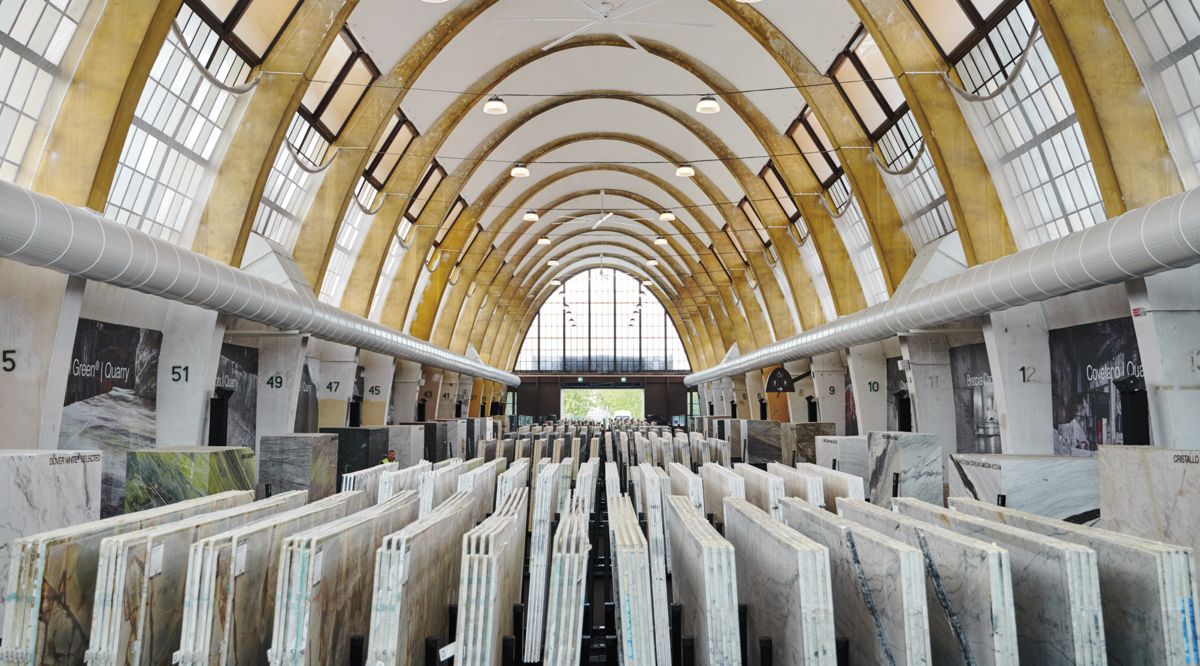
Natural stone continues to be one of the most representative elements of contemporary architectural culture, and each year Marmomac showcases its evolution through an international map of materials, surfaces and applications. In doing so, Verona is transformed into a true “materials library” spanning 76,000 square metres across 12 halls and 8 outdoor areas. From Italy to Brazil, from Greece to India, the exhibition brings together some of the world’s most important quarrying regions, offering a unique overview in terms of both geological diversity and aesthetic research. Arabescato Orobico, Travertino Romano, Ceppo di Gré, Pietra di Luserna, Bardiglio, Verde Alpi and Botticino illustrate the geological richness of the country, with 13 regions involved – currently or historically – in the production of high-quality stone materials.
These stones have shaped the history of architecture, from the Pantheon in Rome to St Peter’s Basilica, through to contemporary landmarks such as Jean Nouvel’s Louvre Abu Dhabi and Kengo Kuma’s Stone Museum, both architects having featured among the distinguished figures who have passed through the halls of Veronafiere. Italy boasts more than 300 varieties of natural stone, reflecting a culture of materiality that continues to find expression in architecture and interior design. The continuity between heritage, design and manufacturing remains one of the key strengths of the Italian natural stone sector, which today comprises around 3,200 companies and more than 34,000 employees.
Combined turnover – including both materials and processing technologies – amounts to €4.5 billion, while exports account for 70.8% of national production, equivalent to €3.1 billion. The global natural stone sector – encompassing marble, granite, quartzite and other stone surfaces – is today characterised by a broad and well-established production geography. Within this context, Italy maintains a distinctive position thanks to its ability to compete at the premium end of the market, where the value of materials is closely linked to design quality and attention to detail. It is precisely this cultural dimension that defines the deeper significance of natural stone: a material that spans eras and civilisations without losing its expressive power, and which continues to serve as a common language between the past and the contemporary world.
From the Pentelic marble of the Acropolis in Athens to the granite used in the temples of southern India, and the marble of the Lincoln Memorial in Washington, the history of architecture is marked by a continuous and enduring relationship between material and construction. Within this global framework, Marmomac becomes the meeting place for the international geography of contemporary stone, where materials from Europe, the Middle East, Asia and South America come together within a single, collective narrative of material culture. The exhibition’s strong international dimension was once again confirmed at the last edition, where 68% of exhibiting companies came from abroad and more than 50,000 professionals travelled to Verona from 140 countries, reaffirming Marmomac’s role as the world’s leading platform dedicated to natural stone.